The stock market plays a crucial role in the global financial system. It allows companies to raise capital for expansion while giving investors the opportunity to grow their wealth. Today, millions of people around the world participate in stock markets, buying
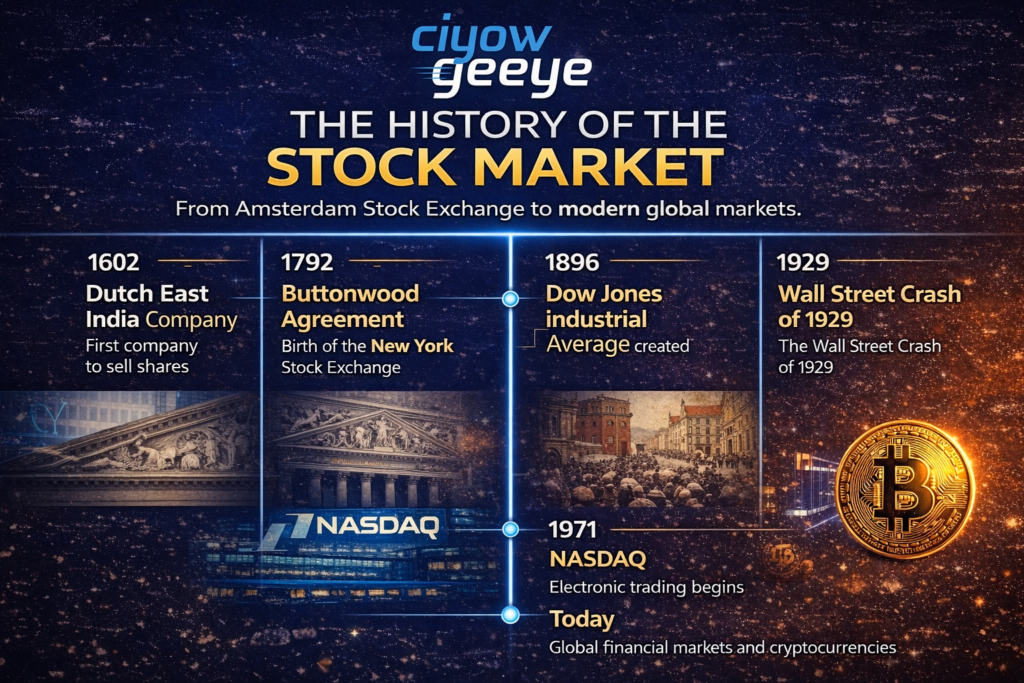
and selling shares of companies across different industries. However, the concept of the stock market did not appear overnight—it developed gradually over several centuries.Early Beginnings of Stock TradingThe origins of the stock market can be traced back to the early 1600s. One of the first companies to offer shares to the public was the Dutch East India Company in 1602. Investors could buy shares in the company and receive a portion of its profits. This innovation allowed businesses to raise large amounts of capital from multiple investors instead of relying on a single wealthy backer.Trading of these shares took place in Amsterdam, where merchants gathered to exchange ownership stakes in companies. This trading activity eventually led to the establishment of the Amsterdam Stock Exchange, widely recognized as the first formal stock exchange in the world.The Development of the American Stock MarketStock trading eventually expanded to the United States. In 1792, a group of brokers signed the Buttonwood Agreement under a tree on Wall Street in New York City. This agreement set rules for trading securities and formed the foundation of the New York Stock Exchange (NYSE).Over time, the NYSE grew into one of the most powerful financial marketplaces in the world, attracting companies seeking investment and providing investors with access to business growth opportunities.Industrial Growth and Market ExpansionDuring the 19th and early 20th centuries, the stock market expanded rapidly alongside industrial development. Companies in industries such as railroads, steel, banking, and manufacturing began issuing shares to raise money for expansion. Investors were eager to participate in these businesses, hoping to benefit from their success.In 1896, the Dow Jones Industrial Average was created to track the performance of major companies listed on the market. This index became one of the most important indicators of economic performance and market trends.The Great Crash of 1929One of the most significant events in stock market history was the Wall Street Crash of 1929. During the 1920s, stock prices rose rapidly as speculation increased. When investor confidence suddenly collapsed, stock prices fell dramatically.The crash triggered the Great Depression, a severe global economic crisis that lasted for many years. In response, governments introduced stronger regulations to improve transparency and protect investors.The Rise of Electronic TradingTechnology began transforming the stock market in the late 20th century. In 1971, NASDAQ became the first electronic stock exchange, allowing trades to be executed through computer networks rather than traditional trading floors.This innovation increased the speed and efficiency of trading and made financial markets more accessible to investors around the world. Eventually, online brokerage platforms enabled individuals to trade directly from their computers and mobile devices.The Modern Global Stock MarketToday, stock markets operate across the globe, with major exchanges such as the London Stock Exchange, Tokyo Stock Exchange, and New York Stock Exchange handling trillions of dollars in daily transactions.Large multinational companies including Apple, Amazon, and NVIDIA dominate global markets today. At the same time, digital assets such as Bitcoin have introduced new forms of investment that continue to reshape the financial landscape.ConclusionFrom its beginnings in small merchant gatherings to today’s advanced electronic trading systems, the stock market has evolved dramatically over the centuries. It remains a vital engine for economic growth, innovation, and wealth creation. Despite occasional market downturns, the stock market continues to play a central role in shaping the global economy.