



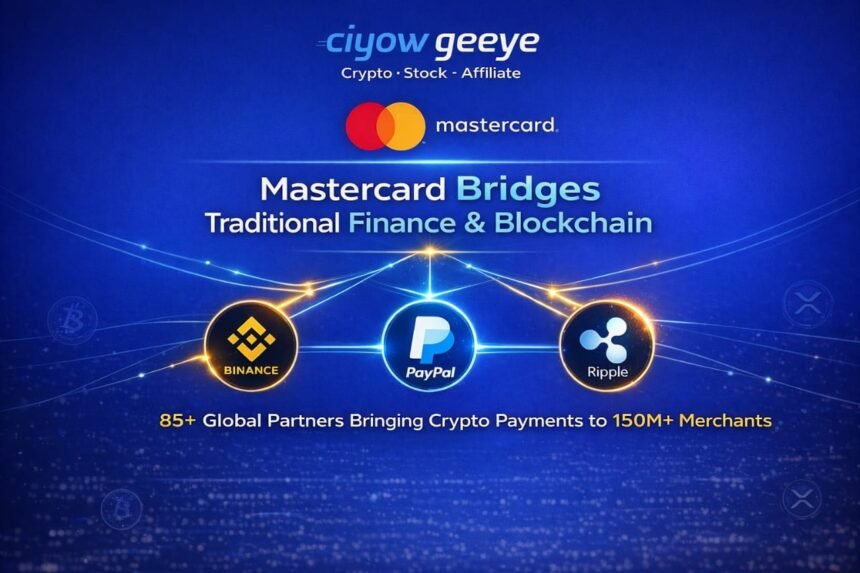
Mastercard Bridges Traditional Finance and Blockchain with Massive Crypto Partnership Initiative
In a landmark move signaling the merging of traditional finance and blockchain technology, Mastercard has launched its Global Crypto Partner Program. This initiative brings together more than 85 industry leaders, including Binance, PayPal, and Ripple, to reshape how digital assets are used in global commerce.
Announced on March 11, 2026, the program represents a strategic shift for Mastercard. Instead of treating blockchain as a separate financial system, the company aims to integrate on-chain technology directly into its global network, which already supports more than 150 million merchant acceptance locations worldwide.
The Power Trio: Binance, PayPal, and Ripple
Although the initiative includes dozens of partners, three companies play particularly important roles:
Binance
Binance contributes its massive global user base and liquidity as the largest cryptocurrency exchange in the world. Its involvement helps scale crypto-linked payment cards and wallet integrations, enabling millions of users to spend digital assets more easily.
PayPal
PayPal focuses on consumer and merchant payments. With its large merchant ecosystem and stablecoin PayPal USD, PayPal helps enable seamless “pay with crypto” experiences for online and retail transactions.
Ripple
Ripple plays a key role in financial infrastructure, using the XRP Ledger and the digital asset XRP to improve cross-border payment systems. The goal is to reduce costs, delays, and complexity in international B2B transfers.
Strategic Objectives for 2026
Mastercard’s strategy focuses on practical blockchain applications rather than speculation. The program is built around three core pillars:
- Seamless Cross-Border Remittances
By using stablecoins and digital assets, Mastercard aims to enable near-instant international transfers, reducing reliance on traditional systems like SWIFT that often take several days to settle transactions. - B2B and Commercial Payouts
Businesses will gain access to programmable payments, allowing funds to be automatically released when smart-contract conditions are met. This can significantly improve global supply chain payments. - Standardized Security and Compliance
Through Mastercard Crypto Credential, the company is introducing standardized identity verification tools to ensure blockchain transactions comply with global AML (Anti-Money Laundering) and KYC (Know Your Customer) regulations.
Why It Matters: The “On-Chain” Evolution
According to Raj Dhamodharan, Executive Vice President of Blockchain and Digital Assets at Mastercard, the crypto industry has moved beyond its experimental phase. Digital assets are now evolving into practical financial tools for everyday use.
The program also includes stablecoin leaders such as Circle and Paxos. By bringing multiple competitors into a shared framework, Mastercard aims to create a common standard for digital asset payments.
A Who’s Who of Blockchain Innovation
In addition to the major partners, the program includes a wide range of technology companies and financial platforms:
Layer-1 Networks: Solana Labs and Polygon Labs
Security & Infrastructure: Fireblocks and BitGo
and MoonPay
Banking Integrations: SoFi and its Galileo Financial Technologies
The Bottom Line
Mastercard is not simply allowing crypto payments—it is rebuilding global payment infrastructure to be blockchain-native.
For consumers, this could mean:
Faster global transactions
Lower transfer costs
Financial services operating 24/7 worldwide
Conclusion: A Unified Future for Global Finance
The expansion of Mastercard’s Crypto Partner Program represents the construction of what many experts call the “Internet of Value.”
Key takeaways:
The Bridge Is Built: Mastercard is positioning itself as the link between the traditional financial system and the trillion-dollar digital asset economy.
Utility Over Hype: The focus is shifting from crypto speculation to real-world payment utility.
A New Standard: The Mastercard Crypto Credential could become the global compliance framework for blockchain payments.
In short, this collaboration signals the end of the siloed era of finance. The future financial system may operate as a single, high-speed global network, where the technology behind payments matters less than their speed, cost, and security.